
TL;DR
The one thing machines produce nowadays almost for free is still the dominant trading unit within the language services industry: the word. Amid the unstoppable rise of technology, and with only one bargaining asset, every efficiency gain risks becoming a discount on people. We saw it happen with translation memory and machine translation, and if we’re not careful, history will repeat itself with the new generation of AI disciplines focused on verification: AI checking AI, LLM-as-a-judge, etc. If quality estimation separates the low-hanging fruit from the hardest words, the average effort per word that still requires human intervention will only go up — even if the total human workload decreases.
Per-word pricing squeezes two economically different things into a single number: goods (processed words in this case), whose marginal cost is approaching zero because of AI, and labor, whose cost depends on expertise, risk, time, and the quality of the machine-generated goods — assuming machine translation is now the most popular starting point of professional translation workflows. AI didn’t necessarily put the industry’s traditional pricing model under extra pressure. Instead, it exposed its weaknesses.
When the trading unit is a commodity, the price of the unit follows its marginal cost. Rather than stopping the word-based race to the bottom, it’s not unlikely that more and better technology will only speed it up. My two cents: keep the word as a unit of measurement, but stop letting it be the whole price.
Introduction
Last year, after LocWorld54 in Monterey, I had so much to think about that I ended up writing quite a bit. Following a three-part series on the state of the language services industry, a TMS market report, an attempt to scope out the rising quality estimation market, and LocWorld56 in Vancouver, I find myself in exactly the same situation.
This time, I’m stepping outside my technological comfort zone (hence I reserve the right to be wrong) to tackle a topic that came up repeatedly in corridor conversations at TAUS and LocWorld: pricing. I applaud the fact that people aren’t holding back when discussing the race to the bottom, the end of per-word rates, AI taxes, or the shift towards governance and risk management. Nevertheless, many conversations remain focused on describing the problems, while proposing tangible solutions seems particularly difficult. (Spoiler alert: this piece also sticks to the problems, but tries to explain where they come from. The alternative deserves a piece of its own.)
ModelFront is one of the first companies to sound the alarm in earnest and, in doing so, kick certain establishments in the shins. With the launch of OpenLoc, the company is paving the way for TMS to become open and, more importantly, free platforms. Unsurprisingly, ModelFront CEO Adam Bittlingmayer, ex-Google Translate, often cites Android as inspiration: a textbook case of the "commoditize your complement" theory. Make the adjacent product free and demand for your own goes up.
Here’s the catch: buyers might read a free TMS as a saving and hand the license budget back to finance. However, the budget shouldn’t disappear — it should move. The main question is: who will capture the value released by cheaper technology and run away with it? Will it reach the people doing the actual language work, through better rates and more room for expertise? Or will it be monopolized by a new layer of vendors selling verification? I believe the answer depends less on the technology than on the unit we trade in.
The per-word stranglehold
One per-word price covers two fundamentally different things: output (processed words) and labor (linguists checking, creating, editing, and deciding). Their economics move in opposite directions. When deploying a language model, the marginal cost of another million words is negligible compared with the human effort traditionally required to produce them. Human effort doesn’t follow this curve: a linguist’s hour costs the same whether it’s spent on a thousand easy words or a hundred hard ones.
Before AI, the bundle was defensible because the word served three purposes:
Measure of effort: Output was predictable (approx. 2,500 words per day), so word count was a reasonable proxy for time.
Proxy for value: Imprecise, but more words generally meant more work, and more work was accepted as a fair stand-in for the value delivered.
Budgeting unit: Costs were known before work started.
AI killed the first and exposed the second. Two 1,000-word tasks can take one hour or one day, depending on MT quality, content type, and the skill set of the contracted linguist. And when generating words costs next to nothing, the value shifts away from producing them and towards ensuring the outcome: compliance, market fit, reduced risk, etc. A dosage instruction on a medicine leaflet and a phone case description can have the exact same word count. Nobody will argue they carry the same value.
Only the third purpose survives, and that’s the stranglehold: the word no longer measures effort or value, but it remains the only unit procurement can compare.
Outside the translation industry, labor is usually priced by effort. Replace your car’s timing belt and the belt itself will probably cost somewhere between €50 and €100. The bill runs into several hundred euros (if not higher) because the mechanic takes half the engine apart to reach it. Nobody at the workshop pretends the price is about the belt. Translation has priced labor by the belt for decades. Efficiency gains keep being passed on as a lower per-word rate, without anyone questioning whether the work itself has changed.
The per-word logic is so deeply ingrained that even TMS adopted it. With the breakthrough of neural machine translation, TMS providers quickly realized that more words could be translated with fewer seats. As a result, many providers moved towards volume-based pricing, often charging by source words times target languages, excluding connectors and other add-ons. Software licenses, machine output, and human effort got squeezed into the same unit. As a matter of fact, Smartcat named its billing unit "Smartwords" and refers to it as a currency. You can also ask yourselves how many times you’ve tried to figure out how many tokens the average word in your primary source language consists of.
With the context in place, let’s explore five economic reasons why per-word pricing in the traditional sense is becoming increasingly difficult to sustain. They build on each other: the first explains why the price falls, the next two who pays for it, the fourth why quality follows the price down, and the fifth why every cut ends up at the bottom of the supply chain.
1. A rounding error, sold by the word
AI made the cost of generating words collapse by orders of magnitude. The price of delivering a translation hasn’t.
Google Cloud Translation charges $20 per million characters for machine translation: about $0.00012 per word, estimated at six characters per word. Let’s assume that a large language model with context, prompts, and retries costs around $0.002 per word, while buyers are quoted something in the broad range of $0.05–0.15 per word for a linguist correcting machine output, regardless of which machine produces it.
For context, Google says people translate around 1 trillion words every month across its translation products, including Translate, Search, Lens, and Circle to Search. Priced at the low end of that range, a single month of this volume would cost $50 billion — not far from the roughly $73 billion the entire language services industry is estimated at by Nimdzi Insights. In other words, most of the world’s translation volume is already produced at industrial scale outside the per-word economy.
Even in the most generous scenario — the LLM estimate against the lowest post-editing rate — machine output would account for only 4% of the total price. With conventional machine translation, the figure is well below 1%. The remaining 96–99% goes to labor, verification, and margin. The words themselves have become a rounding error in the cost of delivering a translation.
Why does this matter? When buyers compare suppliers by the word, they are encouraged to treat the service as interchangeable and make price the key differentiator. Economists would classify this as Bertrand competition: when suppliers compete on price for what buyers perceive as the same product, prices are pushed down towards marginal cost.
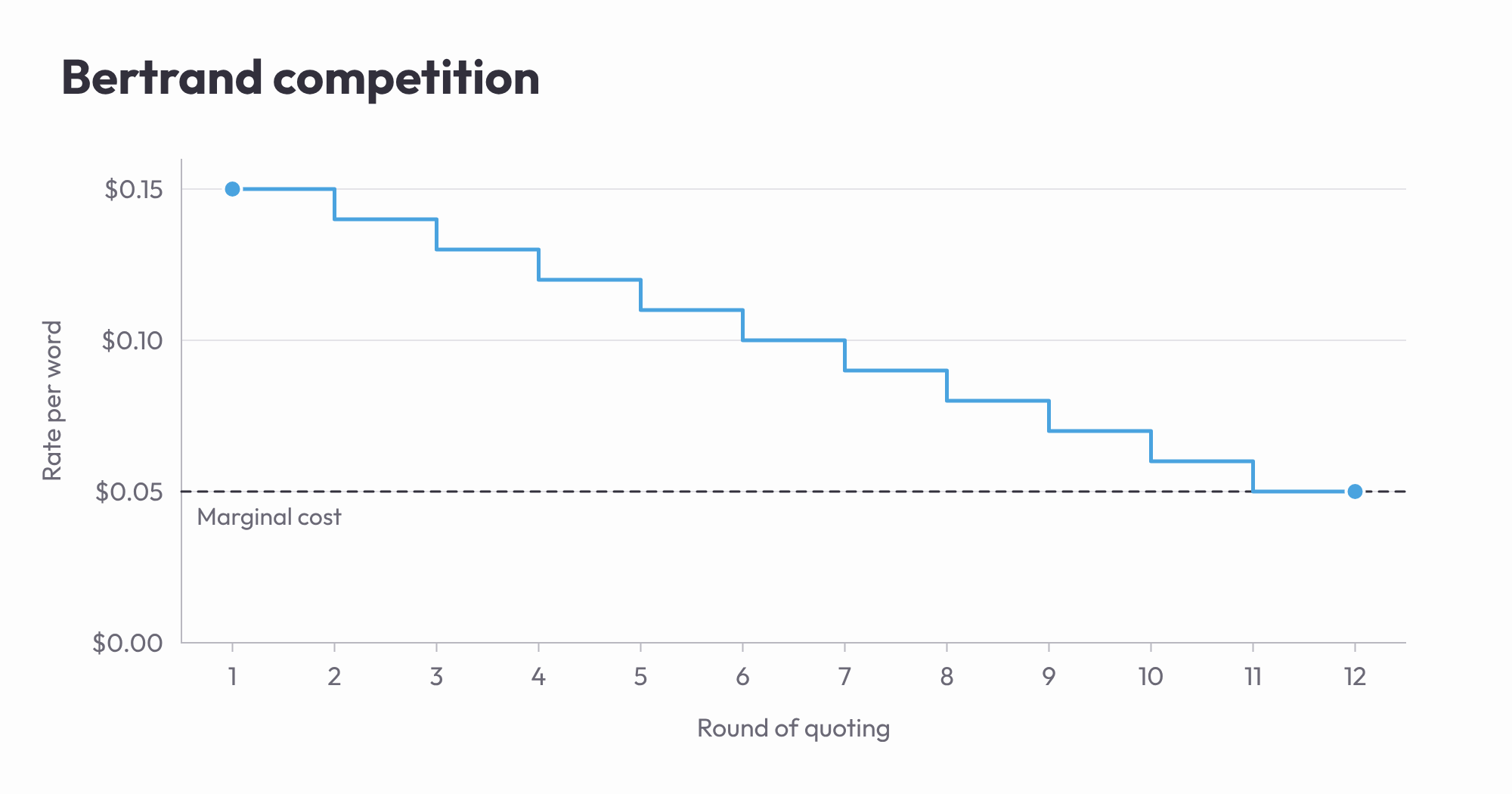
In all transparency, translation isn’t a textbook example of Bertrand competition: quality, expertise, relationships, and trust still differentiate suppliers. None of that shows up in a per-word quote, so the comparison ignores it, even when the underlying work differs considerably. The result is a market in which prices are increasingly anchored to a standardized unit of output, while most of the actual cost lies in making the output fit for purpose.
2. Coupons on labor
In translation, a discount has traditionally meant charging less for work that isn’t necessarily easier.
Not charging for 100% TM matches is fair as they represent work the buyer has already paid for. Fuzzy matches, on the other hand, standardized the practice of discounting broken translations, in this case based on similarity rather than actual effort. The more a new sentence resembles an old one, the less the linguist gets paid for it.
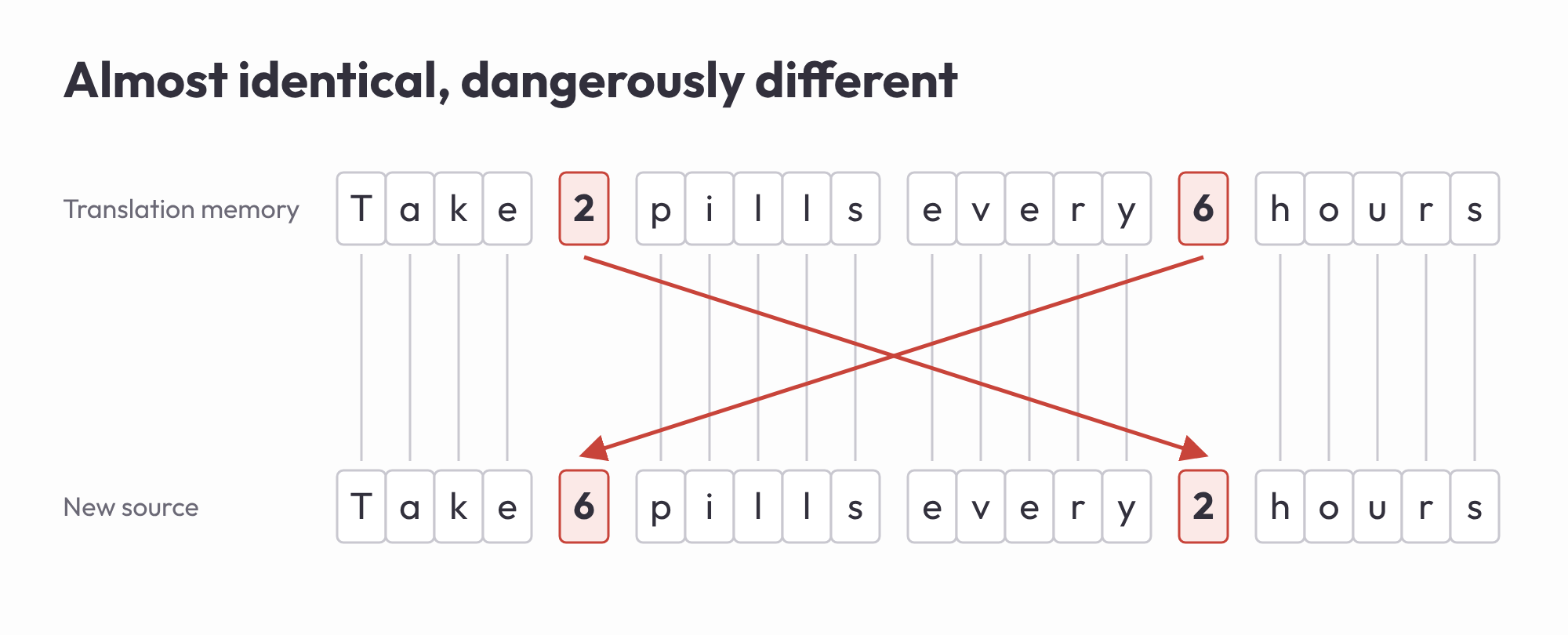
Similarity says little about effort, and nothing about risk. My favorite example: imagine the TM contains "Take 2 pills every 6 hours" and the new source says "Take 6 pills every 2 hours." Two digits have swapped places, so the segment comes in as a high fuzzy match with a matching discount. This is precisely the segment where a mistake slipping through the cracks would do the most damage. Naturally, with fuzzy match repair technology, this particular sentence is sold to the buyer as a fuzzy match, but bought from the linguist as a full match.
In my experience, linguists rarely object to fuzzy matches, and some still prefer them over MT, even at match rates as low as 75%. The reason isn’t necessarily economic. A fuzzy match is something a linguist created; it feels like their own work coming back, while machine output is someone else’s mess to clean up. Behavioral economists call this the endowment effect: people value what they consider theirs more than an equivalent thing that isn’t. That’s perhaps why the fuzzy-match discount is accepted without much resistance, and why it matters, i.e., it sets the precedent.
Machine translation applied the same logic, minus the sense of ownership — and minus the limits. A translation memory only offers a discount where it has a match; an MT engine has a suggestion for every segment. In the neural MT era, the discount therefore spread from part of the translation task to all of it.
A rates survey distributed by the Belgian Chamber of Translators and Interpreters (report dated August 2025) puts the median agency rate at €0.05–0.06 per word for post-editing against €0.09 for translation. The few respondents who bill agencies by the hour reported roughly €25 for post-editing against €32 for translation — a small sample, so read it as an indication. That’s the going rate for a university-educated professional fluent in at least two languages, with solid knowledge of culture, literature, and politics, along with in-depth specialization in a particular field. My 18-year-old son’s weekend hustle might pay better after taxes.
3. The hardest words at the lowest rates
Quality estimation takes the easy segments out of the mix, but doesn’t touch the rate.
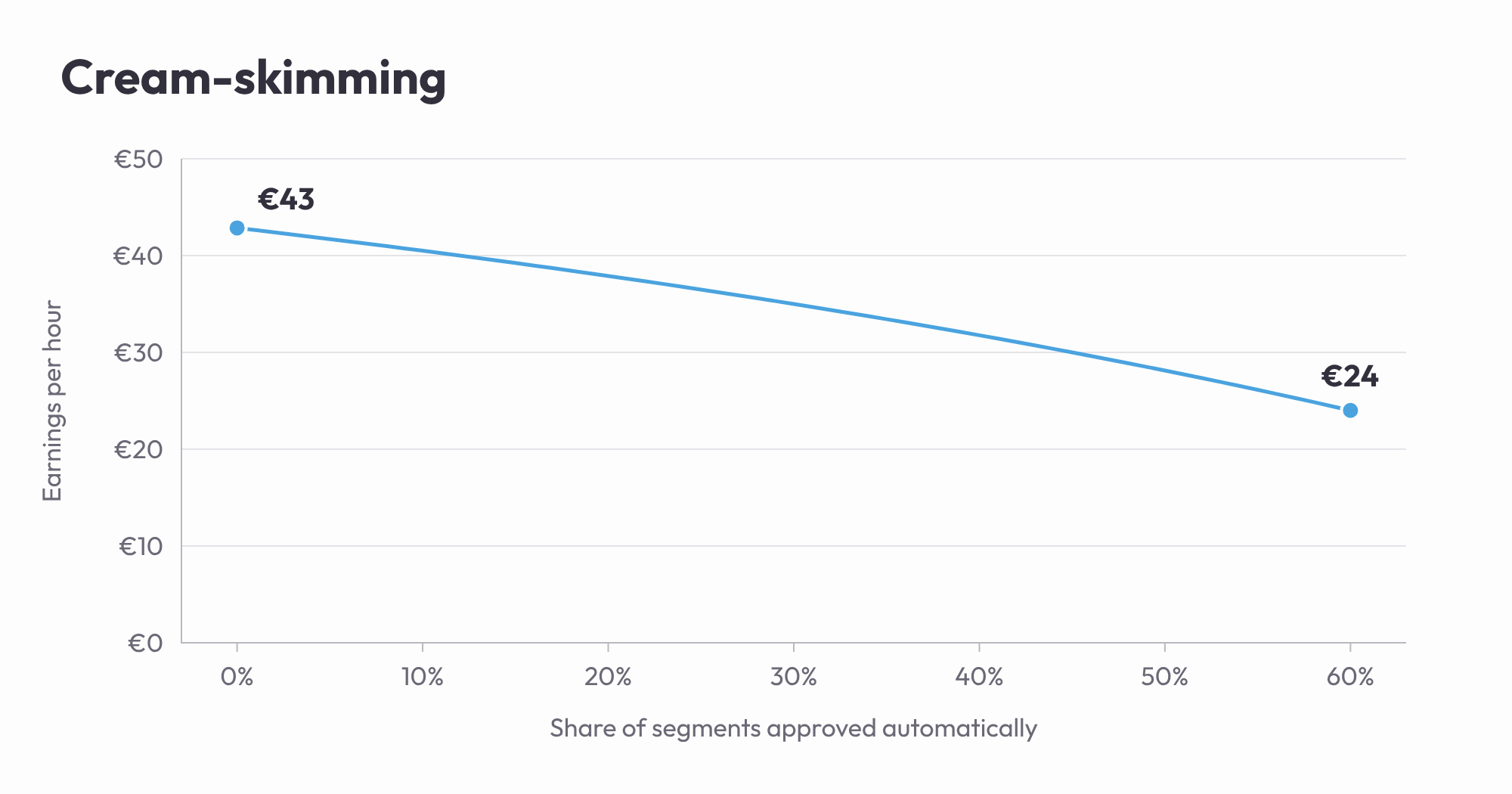
Quality estimation is intended to predict whether a machine-translated segment is good enough to move to the next step in the workflow. QE routing acts on that prediction: segments that pass are approved automatically, and segments that fail go to a linguist. Great for the buyer. For the linguist, the paid segments that only require a Ctrl+Enter disappear overnight.
Economists call this cream-skimming, and postal services are the textbook case. A stamp costs the same whether the letter goes across the street or to a remote farm. That only works because cheap city deliveries pay for expensive rural ones. When private couriers entered the market, they took the city mail and left the national operator with the farms, at a stamp price that no longer covered them. The per-word rate is the linguist’s stamp. Quality estimation takes the easy segments, and the linguist keeps the remote farms, at a rate that was calculated for the whole mix.
The obvious alternative is the hour. Yes, paying by the hour rewards slowness, and even law firms are moving away from it: 87% of top Australian firms offer alternatives, and 77% offer capped fees (Best Lawyers, 2025). Law is trading open-ended hours for a fixed number because much of its work has become predictable. Translation would be giving up a fixed number because its work is becoming less predictable. Both roads lead to the same place: estimate the effort, then cap it. A per-word rate puts all the uncertainty on the linguist, a pure hourly rate puts it on the buyer. The real negotiation is about who carries it.
The workforce is drawing its conclusions. More than a third of translators (36%) say they have already lost work to generative AI, and 43% have seen their income fall because of it (Society of Authors, 2024). The pipeline is drying up: in the UK alone, 28 universities have closed modern languages courses since 2014 (ITI, ATC, and CIOL), and the linguists who do the hard work today aren’t getting any younger. A kitchen that cuts its cooks’ pay every time it buys new equipment eventually can’t staff the dishes that still need them.
As I’m writing this, a LinkedIn post by a freelance linguist with nearly 25 years of experience caught my attention. Its message to fellow translators: don’t confuse the industry’s current purchasing behavior with the value of your professional skills. I couldn’t agree more. The skills haven’t lost their value; the unit they’re bought in has lost its meaning.
4. Buying blind
A per-word price is a receipt with one line on it.
Smartling’s public pricing lists $0.12 per word for AI translation with post-editing. Smartling documents its price table publicly, which is remarkable and pretty unique. Still, in most cases, it’s one number, with no split between machine output, labor, verification, and margin. On top of that, most buyers can’t read the languages they’re buying, so they can’t assess quality. The only thing they can compare is the per-word price.
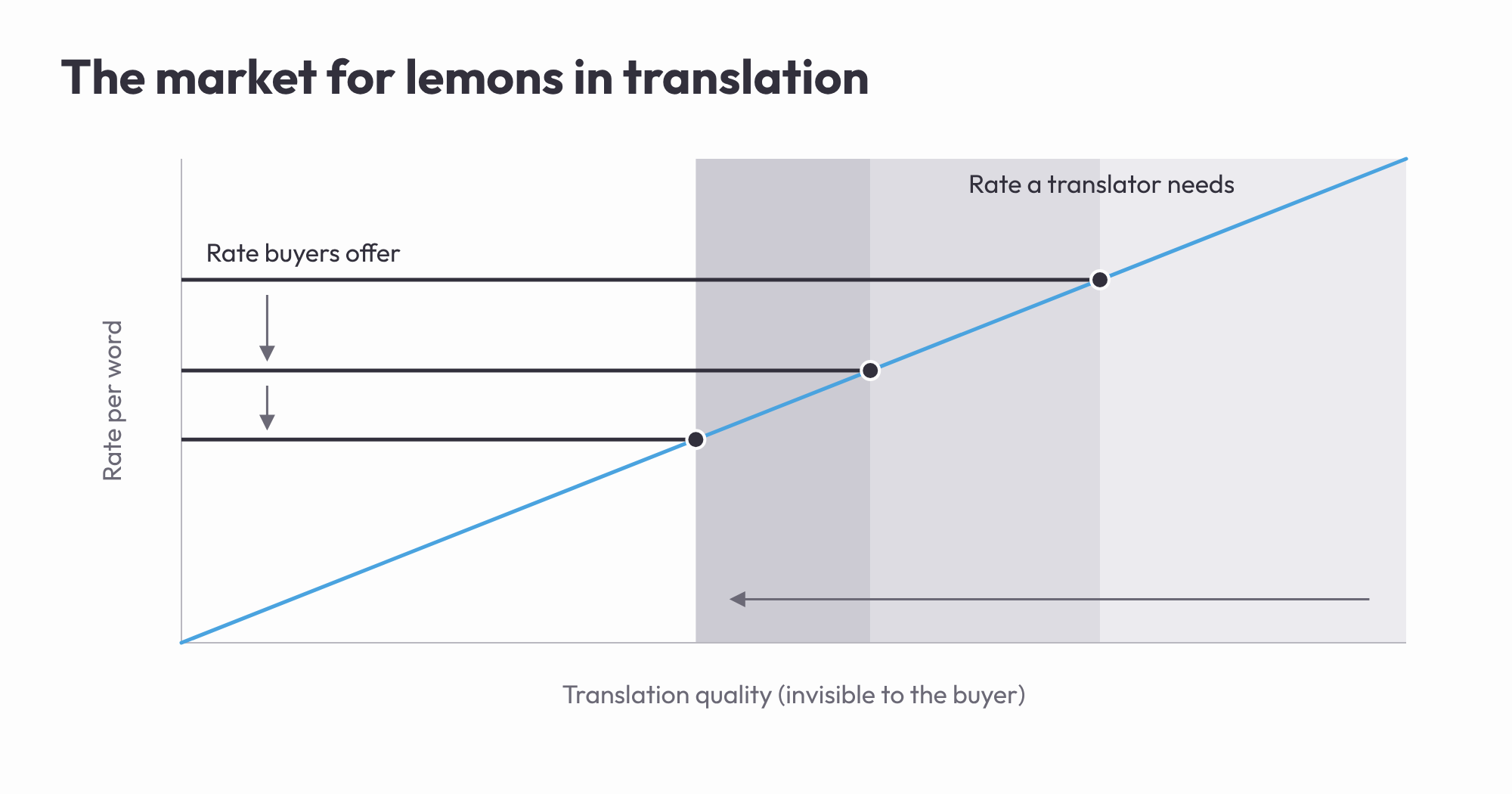
George Akerlof won a Nobel Prize for explaining where that leads. In "The Market for Lemons" (1970), buyers who can’t tell good used cars from bad ones only pay the price of an average car. Owners of good cars leave the market, the average drops, and the cycle repeats until mostly bad cars remain.
Translation works the same way. An LSP that invests in quality, with better linguists, an extra review, or more context, can’t prove it before the task, and the buyer can’t always check it afterwards. The buyer therefore has little reason to pay more for quality they can’t reliably distinguish, and the LSP that spends more simply earns less at the same per-word price. The rational move is to cut the costs the buyer can’t see: a cheaper linguist, a skipped review. Competitors do the same, the going price drops, and the cycle repeats.
Bertrand explains why the price falls, Akerlof explains why quality follows. The race to the bottom doesn’t start in technology, but in a price that shows one number and hides everything behind it.
Of course, procurement wants one number, but one number for the budget doesn’t mean one line for the cost. Construction addressed this with the guaranteed maximum price: materials, labor, and fee are listed separately, the buyer approves one maximum, and if costs exceed it without an approved change, the contractor generally pays the difference. Procurement gets its number, and the buyer sees what’s inside it.
5. A margin on a margin
Every intermediary takes its cut before passing the task on, and the last link in the chain gets what’s left.
A typical translation task travels from the buyer to an MLV, on to a smaller SLV, and finally to a linguist. Every party between the buyer and the linguist is an intermediary, and each one takes its margin from the per-word price it receives. Each link buys words and sells words; whatever it adds in between never appears as a line of its own. The margin is a spread on a unit, not a fee for a service. And spreads stack: if two intermediaries each retain ~40% of what they receive, the linguist is left with a small share of every dollar the buyer pays. And because the buyer’s price is under pressure, every cut at the top travels down the chain to the one party that can’t pass it on.
What does the buyer get for those margins? Very often, processes built for another era. The days when LSPs could wait for 50,000-word documents into 20 languages are over, but the chain still runs on copy-paste, emails, manual triggers, and minimum charges. Content is re-engineered for each party’s tools, and by the time the linguist opens the task, the context and the business purpose are gone. Every handover adds overhead, delay, meaningless machine translation, and a chance for errors. In hospitality, ordering kiosks send the order straight from the guest to the kitchen. A chain in which every link runs its own system and protects its own margin struggles to offer this kind of automation.
The consequence goes beyond the undervaluation of translation quality. It reinforces the notorious perception of localization as a burden and a cost center. When translation feels clunky, expensive, and slow, buyers will be enticed to experiment with AI themselves, and feel positively surprised about the good-looking quality and the speed at which their documents get translated by ChatGPT or DeepL. Furthermore, if they take care of the AI work they would expect their supplier to do for them, why not ask for an additional discount, since the translation is only a quick read away from being perfect?
Economists call this disintermediation: when the parties in the middle cost more than they add, customers go around them. The thing is that many buyers only go halfway, i.e., they keep the chain and ask for the discount, which travels down the same chain and eventually ends up on the linguist’s invoice.
Conclusion
More AI, fewer old habits please.
The five economic reasons explored in this piece point to one underlying problem: the language services industry’s commercial model hasn’t kept up with the economics of the technology it deploys. The per-word price still dominates, even though the word itself accounts for only a fraction of what goes into delivering a translation.
They aren’t five isolated problems, but links in one chain:
A rounding error, sold by the word — Because the word is the unit, buyers compare suppliers on the one element that has become basically free, and the price follows.
Coupons on labor — Because the price can only move per word, every efficiency gain is converted into a discount on human work.
The hardest words at the lowest rates — Because the rate is an average, automation that removes the easy segments leaves linguists with the hardest ones, at a price calculated for the whole mix.
Buying blind — Because the price is a single number, buyers can’t see quality, and suppliers have little reason to keep paying for it.
A margin on a margin — Because every link in the chain trades in the same unit, each cut travels down to the one party that can’t pass it on.
Taken together, they show how much a single per-word price conceals. The word has become a convenient unit for comparing services that are no longer economically comparable.
The answer isn’t to slow down technological progress. On the contrary; the industry needs more AI, not less, in different areas — from machine translation and verification at scale to project and vendor management, MCP for connectivity, and agentic automation. The supply of conventional human translation, sold by the word, exceeds the demand for it, which is exactly why its price keeps falling. At the same time, the demand for AI-driven localization exceeds the available supply. Businesses already produce more multilingual content than traditional localization models can economically deliver, and few providers can offer more than the old workflow with an MT model bolted on.
Creating value is one thing, capturing it is something else. Buyers can benefit from lower costs and greater reach; LSPs from higher volumes, leaner operations, and new services; linguists from specialist work and verification; and technology providers from the infrastructure that makes it possible. There is room for everyone to benefit, but no guarantee everybody will. Which brings me back to the question from the introduction: who runs away with the value released by better and cheaper technology? As long as the word is the price, the answer is predictable: the buyer gets a discount, the verification vendor gets a fee, and the linguist gets the hardest words at the lowest rates. If every efficiency gain simply becomes another per-word discount, the industry will reproduce its old habits with fancier technology.
The commercial model needs to change alongside the technology. Not every word requires the same production process, human involvement, or level of verification. Some content can be translated automatically; other content needs specialist expertise, additional review, and someone willing to stand behind the result. Those are different services, with different costs and different value propositions, that deserve to be priced accordingly.
The word itself isn’t going away. It remains useful for measuring volume, estimating workloads, and managing budgets, but it should no longer be expected to carry the weight of a full-fledged commercial model. What should replace it could be the topic of a future piece.
My two cents: keep the word as a unit of measurement, but stop letting it be the whole price.