The TMS Market: 2026 Snapshot
Introduction
For more than 30 years, the TMS has been the beating heart of all professional translation activity. For every problem or requirement — from connectors and MT models to proxies, reports, and string capabilities — the spontaneous reflex was to turn to the TMS market in search of a solution. It became so central to our operations that it grew into the exclusive starting point and end point for language operations.
The TMS monopoly created a deep dependency where we mirrored innovation to TMS compatibility. For certain advancements, this worked well. Neural MT, for example, was bolted on right after its breakthrough as it could easily be sprinkled over XLIFF units and exposed as an additional translation result alongside TM matches. Nevertheless, every step beyond the safety zone of translation memories, term bases and CAT grids gradually increased the complexity of new development.
Together with my good friend and mentor Konstantin Dranch, I devoted years to TMS to learn their intricacies in a hands-on way. When we last estimated the TMS market size at the end of 2023, we arrived at a figure of $0.3 billion — larger than ever at the time. With LLMs still in their early stages, we witnessed the dawn of a new era in which localization professionals anticipated an abundance of innovative features and an unseen competitive edge.
Nonetheless, if the advent of LLMs has taught us one thing, it's that sprinkling peacockish GPT features over segmented text, fuzzy matches, and term base hits isn't sufficient to make LLMs the go-to engines for localization programs. While the whole planet has had a taste of Claude, AI agents, and vibe coding, the language industry still relies on processes rooted in the DTP era, driven by a static, context-poor database that was invented 30 years ago and hasn't fundamentally changed since. No language tech category illustrates this stagnation better than TMS.
After almost three years of radio silence, the time has come to publish another snapshot of the TMS market — one that feels different from previous editions, and one in which familiar names such as Across and Lingotek have completely disappeared. The resulting report is structured around the following themes:
Unstoppable Smartling, fast-growing Crowdin
The LSP giants
The pure-tech market leaders
The challengers
Other (Lokalise, Weglot, wxrks)
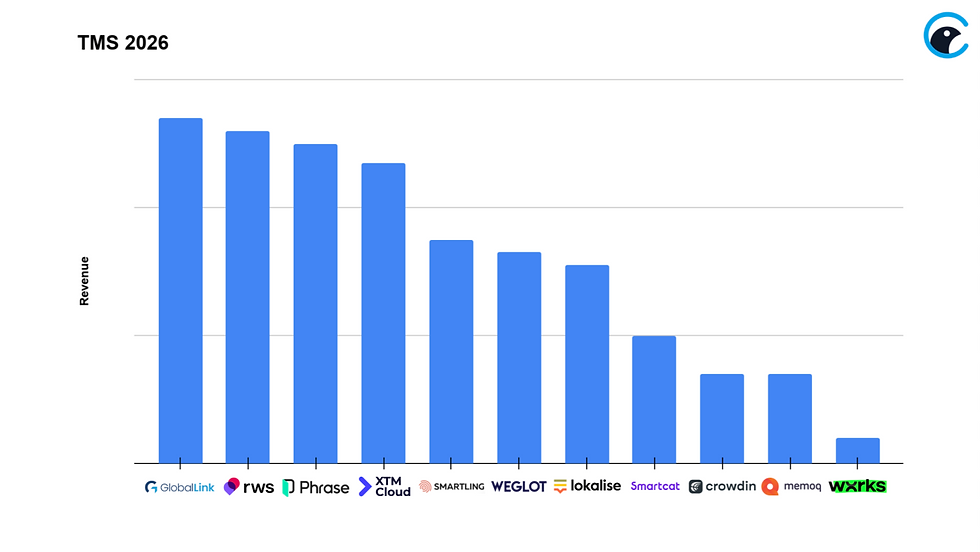
Unstoppable Smartling, fast-growing Crowdin
The primary conclusion of this report is undoubtedly the unstoppable growth of Smartling. While certain TMS providers have LSP roots and gradually expanded into technology, Smartling took the opposite route, evolving from a pure-play TMS provider into a tech-enabled LSP.
Smartling seems to have cracked the code of enterprise localization, offering an impressive portfolio that includes TMS, CAT, connectivity, AI, and managed services under one roof, thus speaking the language of the C-suite. We estimate that Smartling's current revenue figure is in the nine digits, with at least 30% coming from technology sales, thereby entering a market segment that is traditionally populated by TransPerfect, RWS, Translated, and LILT. Without a doubt, Smartling is the fastest-growing translation company in the world, regardless of how "translation" is defined in this context.
Meanwhile, Crowdin's mission to become a GenAI-first TMS is translating into strong growth figures. Crowdin has grown from $1 million to an estimated $14 million in revenue in only a few years. The increasing maturity of its sales and marketing team, which has always had a robust product to support, is resulting in figures that are mounting up.
Today, Crowdin's staff consists primarily of engineers who constantly challenge the status quo in the language technology space, ship AI-driven features at the speed of light, and are not afraid to pull the plug on features with low adoption. If your RFP checklist includes "agents," "AI pipelines," "RAG," "vibe coding," etc. Crowdin will quickly appear on the radar. What particularly stands out is the Crowdin Store — a connector box advertising more than 700 integrations, meaning Crowdin offers more connectors than all other TMS providers combined.
The LSP giants
Surprisingly or not, the largest LSPs in the world still turn out to be among the largest language technology companies as well. We estimate TransPerfect's and RWS's licensing revenues from TMS and MT to be comparable and still higher than those of the pure-play technology market leaders. Both industry leaders also seem to follow a comparable acquisition cadence, with TransPerfect acquiring Wordbee and Unbabel's IP, and RWS expanding its footprint in AI dubbing through Papercup's IP. However, with Phrase's and XTM's revenues approaching $50 million, the gap between the pure-tech players appears to be gradually narrowing.
The most noteworthy developments among the LSP giants are:
TransPerfect embedding Unbabel's Tower LLMs (Widn) as the primary translation engines within the GlobalLink suite, moving from NMT to LLM.
RWS retiring several of its legacy TMS platforms. WorldServer seems to have survived the consolidation effort.
A quick trip down memory lane reconfirms that SDL/RWS once held a 50% share of the TMS market. The market may still have its giants, but it no longer has a singular center of gravity.
The pure-tech market leaders
Phrase entered the TMS realm as Memsource in 2010-2011 as one of the first cloud-based CAT tools, after XTM Cloud. Memsource gained popularity as its internal ML team pioneered several AI features such as predictive MT quality scores and MT routing. It is a public secret that Memsource made extensive use of the data processed by its users in the system to train AI models.
The Carlyle Group acquired a majority stake in Memsource in 2020 at an estimated $45 million valuation (7x). In 2021, Memsource acquired Phrase, then merged and rebranded. Today, poised to challenge RWS and TransPerfect for leadership, Phrase is one of the most comprehensive enterprise TMS on the market. When analyzing the numbers, Phrase is the pure-tech market leader with an estimated $50 million in sales.
In terms of branding, Phrase likes to present itself as an ecosystem of proprietary localization products, but was caught by surprise after the GenAI breakthrough and had to review its strategy; from own models to commercially available models. Their Orchestrator is a unique initiative but might hit obsolescence quickly in the current landscape where workflow builders like Make.com and n8n are omnipresent and, paradoxically, integrate excellently with Phrase because of the quality of its detailed API.
On the other side of the enterprise TMS spectrum, there's XTM. Traditionally, XTM is known for its legacy strategy to migrate SDL TMS and WorldServer clients, resulting in top contracts and an impressive client portfolio.
XTM has chosen a clear direction after the K1 investment and the integration of XTRF in the investment management family: M&A. The journey started with the acquisition of Netherlands-based Rigi.io at a revenue of around $20 million at the time. After having acquired Locale.to, TXTOmedia, and FlowFit, XTM now arguably owns the most comprehensive localization ecosystem in the market, offering solutions for the buy side as well as service providers of all sizes. With the acquisition of Transifex boosting XTM's revenue to an estimated $47 million, we anticipate that XTM's next significant move will be inward: unifying this portfolio into a single, composable platform where a shared intelligence layer connects every product into a coherent operating system rather than a collection of individually acquired assets.
The challengers
memoQ has long been one of the few top TMS players to resist the temptation of M&A, somewhat surprisingly remaining in the hands of the founders. After the GenAI explosion, memoQ took immediate steps to harness LLMs with memoQ AGT, quality estimation through ModelFront and TAUS, and the acquisition of Globalese.
Once the biggest Trados challenger and the proud provider of the most comprehensive and robust CAT on the market, memoQ now finds itself in the midst of a deep transition from its much-praised desktop client to a browser-based translation environment — a shift that undoubtedly comes with an impact on the continuation of its AI program. At the same time, memoQ seems determined to stay loyal to the features that catapulted it to the TMS elite: a powerful TM architecture, cascading file filters, LiveDocs corpora, and a solid workbench for linguists.
While memoQ has shown appetite for expansion into new markets such as the Arabic-speaking region, the company has been busy with several side initiatives. memoQ RFP, the company's spin-off offering a cloud-based platform to efficiently respond to RFPs and other business questionnaires, rebranded as Breeze with memoQ as an angel investor. The founding of a new spin-off, Language Intelligence Corporation, and the launch of its corresponding product, Fluent, were announced recently. What particularly caught the industry's attention was co-founder Balázs Kis stepping back to embark on a new venture on the one hand, and the restructuring of flagship conference memoQfest into a biennial event on the other. The silent killing of Globalese passed without notice. Possible signs of slow growth.
ABBYY Smartcat was launched in 2013 as a translation tool to improve customer stickiness with end buyers. Smartcat spun off from ABBYY in 2017, pivoted to sell to LSPs, and launched sales in the US.
Traditionally, a large part of Smartcat's revenue comes from a commission on payments made to translators via Smartcat's legal entity. In countries like Turkey, many freelancers operate without legal registration and prefer getting paid through electronic money, which may result in a legal hurdle for the freelancer's customers. Smartcat remedies this pain. Add to this that Smartcat has a marketplace of +500K translators, editors and proofreaders, and you know why the system has always been very popular among small LSPs and corporate localization teams. Another particularity is the concept of "Smartwords," which Smartcat describes as "the currency for AI translation and translation memories within the Smartcat platform," and which pioneered volume-based pricing models.
After raising $43 million in a Series C round in 2024, Smartcat mainly differentiates by offering a myriad of functionalities for specialized localization, specifically subtitling (perfect segmentation and excellent video preview), dubbing (AI voices), website localization (proxy), and AI-driven content generation. The real eyecatcher is likely Smartcat's premium support for the Articulate 360 e-learning suite, including full SCORM course packages — a notoriously tough nut to crack.
Other
Lokalise — Scaled down the team after a few years of venture-funded extravaganza, resulting in less prominent industry conference presence and marketing activity. As a TMS that is mainly designed for key-based content, Lokalise may have outgrown the market it originally targeted. Lokalise AI, an agentic translation framework blending translation memories, term bases and style guides, helped generate new sales in the hype wave. Under fresh leadership, Lokalise appears to have reached a strong revenue level, likely exceeding $30 million.
Weglot — After raising $50 million in a Series A funding round back in 2022, Paris-based Weglot grew sales from $11 to $27 million in two years, pure SaaS, reporting $32.5 million ARR by early 2025. Weglot elevated the web proxy into an easy-to-use localization product for marketers and website owners, solving a complex problem in a simple way. It will be interesting to watch how specialized web solutions like Weglot hold up against the rise of Claude Code and n8n (or other AI coding and workflow automation platforms for that matter).
wxrks — TMS with strong LSP grassroots origins, built to overcome the typical limitations of combined TMS and BMS architectures. wxrks thrived during the GenAI breakthrough — still operating under the "Bureau Works" name at the time — and added many LLM-powered features to the platform that the competition didn't seem to think of, "Translation Smells" being the most discussed one. The key question, however, is how much revenue wxrks truly generates from pure technology sales. We estimate total revenue at around $5 million, of which roughly 60% comes from SaaS.


The point about TMS evolving from a solution hub into the default start and end point for language operations is especially relevant. The shift toward more flexible ecosystems is worth watching—I've been using https://vidmuse.pro/suno-link-to-video
The point about TMS dependency is especially timely as connectors and MT models keep reshaping language operations. I’ve been comparing alternatives with a useful resource— https://publer.art
The point about the TMS becoming both the starting and end point of language operations really captures today’s dependency—especially as connectors and MT models diversify. I’ve been exploring alternatives with https://novita.pro/novita-coding-plan
The point about TMS dependency is spot-on—connectors, MT models, reporting, and strings no longer have to live in one central hub. I’ve been exploring alternatives with this resource lately: https://autoseo.art/autoseo-examples-reddit
The point about TMS platforms becoming the default starting and ending point for language operations is especially timely, particularly as connectors and MT models diversify. I’ve been comparing alternatives with… https://pebblely.online/pebblely-free